News
The Future of Sleep Is Closed-Loop, AI-Driven Optimization
The next frontier in sleep is significant: what is happening right now—and what can be done, automatically and intelligently, to help us sleep better?
At SLEEP 2026, Fullpower-AI, together with researchers from Stanford Medicine and UCSF, presented studies drawing on large-scale, real-world sleep data covering tens of millions of nights.
This research reinforces an important principle: sleep is shaped not only by our physiology and behavior, but also by the environment around us. Temperature, humidity, air quality, noise, movement, breathing, bed position, and support all change throughout the night. Each can influence sleep quality, and every person may respond differently.
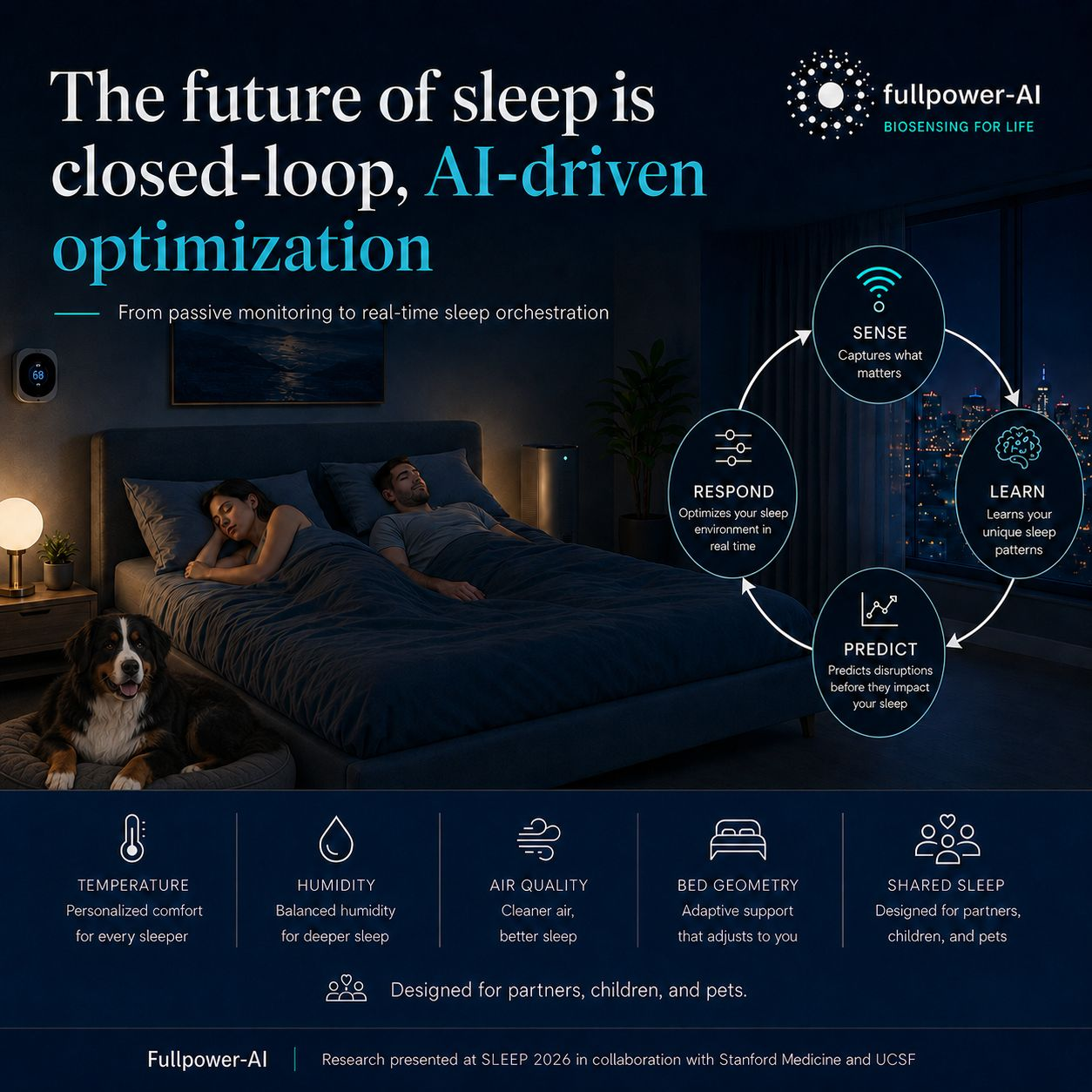
By combining continuous, contactless in-room biosensing with state-of-the-art machine learning and AI, we can move beyond passive monitoring toward an intelligent, closed-loop system that continuously:
- Senses physiology, sleep patterns, and environmental conditions in real time.
- Understands each person’s individual responses and learns from every night.
- Anticipates changes before they become meaningful sleep disruptions.
- Responds by making precise, minimally disruptive adjustments.
- Measures the result and continuously learns whether the intervention actually improved sleep.
That may include dynamically optimizing:
- Room and bed temperature
- Humidity and air quality
- Bed geometry, elevation, and support
- Ventilation, lighting, and sound
- The complex realities and importance of shared sleep—including partners with different physiological needs and preferences, young children who may enter the room or bed, and pets whose movement, position, and body heat can affect everyone’s sleep
The bedroom is not a controlled laboratory, and most people do not sleep in isolation.
One partner may sleep hot while the other sleeps cold. They may have different bedtimes, sleep positions, breathing patterns, sensitivities to movement, or preferences for mattress support. A child may enter the room during the night. A pet may move across the bed, change position, or alter the local temperature.
This is where AI becomes indispensable. The goal is to understand and continuously optimize the entire shared sleep ecosystem.
This represents a fundamental transition from retrospective sleep tracking to real-time sleep orchestration.
With contactless, non-invasive biosensing, Fullpower-AI believes the bedroom will become an intelligent, adaptive environment: continuously sensing, learning, predicting, and responding—all orchestrated by our Koa platform.
Better sleep, for everyone, every night.
About Fullpower-AI®
Our mission is to make advanced AI biosensing universally accessible, empowering better sleep, Remote Patient Monitoring (RPM), and healthspan through real-time, science-validated intelligence. Fullpower-AI® delivers real-time, science-based biosensing and generative AI SaaS platforms—validated with Stanford Medicine and UCSF and deployed globally under long-term commercial licenses. Each platform transforms continuous, contactless sensing into actionable health intelligence.